
MOE to explore smaller classes where needed for more students in pilot with six schools
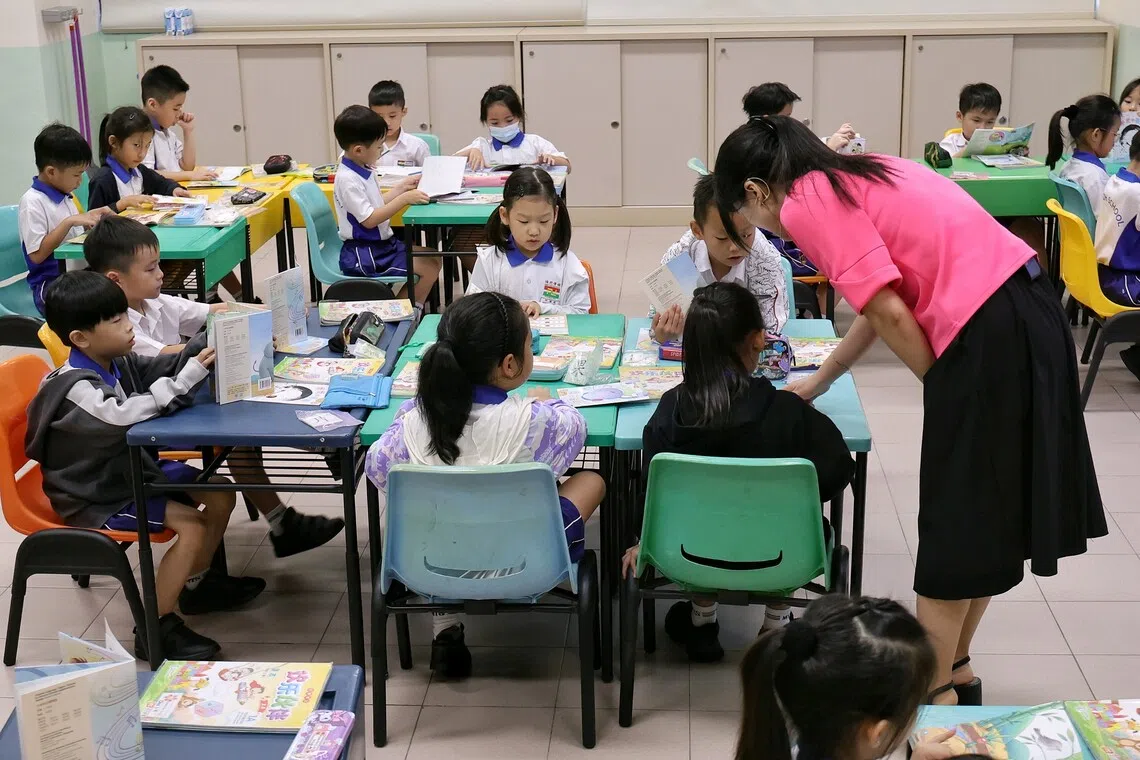
SINGAPORE – More students could benefit from smaller class sizes, as part of a pilot to improve teaching and learning, starting with six schools from January 2027.
Education Minister Desmond Lee said on Sept 16 that smaller classes could allow teachers to give students closer attention and more timely feedback.
But it must be part of a broader redesign of teaching and learning, including reviewing teachers’ other duties and using technology to support their work, he said, addressing about 1,900 school leaders and teachers at the Schools Work Plan Seminar held at Singapore Expo.
The pilot schools are St Anthony’s Canossian, Woodgrove and Zhangde primary schools, and Commonwealth, Deyi and Jurongville secondary schools.
“This is a complex pilot, so we will proceed carefully. We will keep schools updated and share what we learn, before considering how these approaches can be applied more widely,” said Lee.
The Ministry of Education (MOE) will assess whether the changes improve learning and enable teachers to teach and nurture students more sustainably, he said.
Lee noted that smaller classes do not necessarily mean less work. Teachers may have to take on more teaching, as they do in some other countries, he said.
After noticing a foul smell coming from a flat, they alerted Marlina, who informed the cleaners. Other residents also called the police.
The authorities found the decomposed body of an elderly man in the flat, Marlina said.
In August, the four boys from Gan Eng Seng Primary School will take on what they describe as the “biggest thing that has happened” to them.
They will join the National Day Parade (NDP) as part of a segment celebrating Singaporeans who help make the little red dot a better home.
For Rafieq, Aaron Sarandev, 11, Al-Mirza Danish, 12, and Didie Andiqa Muhaimin, 14, it will be their first time taking part in the annual parade.
In 2023, Rafieq’s mother, Marlina, started the community fridge with the help of sponsors for her cash-strapped neighbours. The fridge is located at the void deck of her two-room rental flat at Block 59 Lengkok Bahru.
While food and groceries are kept under lock and key, a separate fridge, which she leaves unlocked, is stocked with milk and drinks that children in the neighbourhood can grab before heading to school in the morning.
Said the mother of five: “I see some residents take a drink for themselves, that’s okay. But they empty the fridge and take three-quarters of the milk for the children.
“This happened so many times.”
Rather than getting Rafieq to guard the fridge, Marlina had another idea: send him and his friends out to patrol the neighbourhood instead.
She said: “We want to tell our neighbours there is this group of children they can reach out to.
“They can help the elderly buy things from the shops or offer help if needed. And when they patrol, they can look out for fire hazards and littering.”
Every day after school, the boys don matching vests bearing their names and the group’s logo, before setting off in pairs to patrol up to six blocks in their estate.
They stay in touch with Marlina and fellow volunteer Fahmidah Farihullah, 21, using walkie-talkies.
The team once had seven members, but now has four.
When they are not on patrol, the boys are often doing homework or playing together.
Rafieq named the group after the police’s Emergency Response Team, inspired by officers who respond to high-risk incidents.
“We can play any time,” the Primary 6 pupil said. “But we want to spend one hour of our time (every day) to serve our community.”
Didie said he joined because he “had nothing to do” and thought the project would give him something meaningful to be part of.
While some residents were sceptical about the boys’ activities, others have praised them for their efforts.
Lengkok Bahru resident Nasha Asrin, 27, a mother of five, said she was glad to see the boys looking out for their neighbours instead of loitering around the estate.
Aaron, a Primary 5 pupil, said the daily patrols have taught him responsibility and perseverance, especially on days when he does not feel like walking around but does so anyway.
Marlina, who helps to discipline and guide the boys, has also seen changes in them.
“I can see the difference in some of them,” she said. “I get feedback from their mothers that their attendance in school is more regular now and their attention span is better.
“I feel they have learnt to be more responsible.” – The Straits Times/ANN
“Nor can we simply hire many more teachers alone as a strategy. Our workforce is limited, and even if we were to hire more teachers, it must be done in a sustainable manner, without compromising quality,” he said. “If teachers need to teach more classes, then we must create the capacity and conditions for them to do so.”
Reviewing teachers’ duties would help them devote more time to teaching, but this must be complemented by tools such as technology, he said.
To simplify teachers’ daily work, MOE will roll out an online platform, Teacher Workspace, to all MOE schools by 2027, following a pilot in around 20 schools.
The platform brings together student information, tools and daily work processes through a single login, reducing the need to navigate different systems. It will help teachers build a fuller picture of each student, coordinate support and communicate with parents and partners.
More functions will be introduced progressively. These include using artificial intelligence to generate relevant insights and first drafts of commonly used administrative reports.
AI is already helping teachers plan lessons and understand students’ learning, Lee said.
At Bukit Panjang Primary, science teachers previously spent considerable time analysing pupils’ written responses for patterns and misconceptions. The AI-enabled Data Assistant in the Student Learning Space online learning portal can now help identify common gaps and strengths almost instantaneously, he said.
On class sizes, Lee said MOE would explore where smaller groups can best support teaching approaches that involve students investigating problems and learning together.
The question, he said, is not just what the ideal class size is, but what learning schools want to enable and what environment best supports it. This builds on the existing approach of providing smaller classes according to students’ needs.
Primary 1 and 2 form classes have been kept at about 30 pupils since 2006 to give children closer attention as they move from pre-school to primary school.
Learning Support Programme classes have about eight to 10 students, while the typical class size at Crest and Spectra secondary schools is 20.
Under full subject-based banding, secondary subject class sizes can also vary according to students’ learning needs and the nature of the subject. “We have observed positive experiences on the ground,” Lee said, adding that smaller classes allow teachers to cater to individual learning needs and engage students.
In response to queries, MOE said the pilot schools were selected based on geographical spread and student profiles, to better understand how the pilot operates in the context of different schools.
One of the six pilot schools, Woodgrove Primary, will explore having smaller classes aligned with pupils’ learning needs. This will create more avenues for teachers to try innovative teaching methods, provide targeted support, and equip pupils with a broader range of competencies, such as critical thinking and social-emotional skills.
For instance, the school has been redesigning its curriculum to stretch pupils with academic strengths and talents.
Its principal Adeline Ng said there will still be form classes, but for subjects like English or maths, pupils may be grouped into smaller classes for support or stretch, depending on the needs.
She noted: “We are very cognisant about mixing the children. It’s very important that children can interact with children of different abilities as well.”
Deyi Secondary principal Chow Weisi said the school is discussing how to reduce curriculum time for some core subjects to free up time for teachers to design their lessons, and for students to explore.
Class sizes in Deyi will depend on the subject and academic level. For instance, there will be 15 to 17 students for some G1 groups – broadly mapped from the Normal (Technical) standard – and around 20 for design and technology, or food and consumer education.
Lianhua Primary was among the 20 schools that piloted the Teacher Workspace earlier in 2026. Principal Pamela Kiew said the tool has brought student information from around six different systems together.
This has saved the teachers time and mental load accessing and consolidating data on the pupils, allowing them to focus on engaging the children, she said.
The data include pupils’ academic and CCA performance, as well as their attendance figures and socio-economic status.
Having different aspects of a pupil’s development consolidated and visualised in charts has helped staff better understand the pupils and how to support them, said Kiew.